


During the early 1980’s a piece of research was commissioned by the Property Service Agency (PSA) which was a former agency of the UK Government, to look in to the value of ironmongery in a construction project, and also the percentage of overall maintenance cost that ironmongery was responsible for (note that this research would have been specifically concerned with public sector buildings). This research was said to state that ironmongery would be worth 1% of a project, whereas it would account for 80% of the overall maintenance.
This figure has been often quoted since then, yet no follow up research has happened in the interim to see how these figures have withstood the test of time. To that extent the GAI, working in conjunction with AMA Research Limited, a UK leader in building construction market research, have now conducted a research project to put these findings to the test against a background of modern methods of construction and an ironmongery world which has been hugely impacted by modern technology and enhanced product standards.

Building Cost v Ironmongery Spend…
This analysis involved the determination of total building costs for new build projects within various end-use sectors and identification of the proportion of the total build costs attributable to ironmongery.
In respect of this the data was obtained through a variety of means including data provided by Barbour ABI, AMA Research’s own library of reports which was supplemented with a series of interviews with architectural ironmongers, manufacturers, distributors and installers of ironmongery to give clarity on key issues. Many GAI member companies played a key part in this research.
Figure 1 (below) summarises the findings of part 1, in relation to ironmongery as a percentage of total building costs.
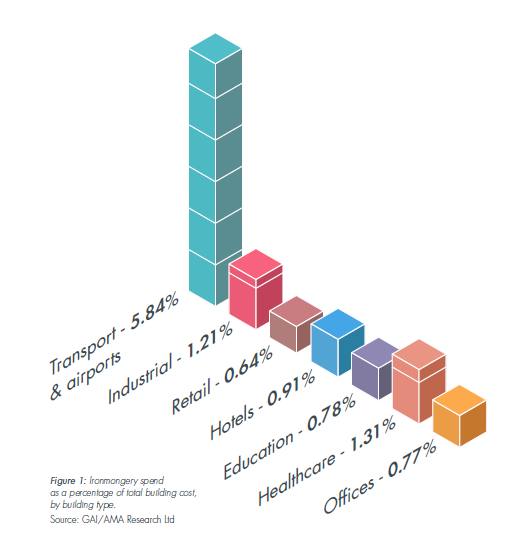
With the exception of airports, the broad analysis indicates that in the majority
of sectors, ironmongery accounts fo rless than 2% of total building costs. This also shows that the overall spend on ironmongery is very much sector-specific
and that the previous figure looked at in the 1980’s at approximately 1% of the
construction value spent on ironmongery is not inconsistent with today’s findings in some sectors, although in some cases it is much higher.
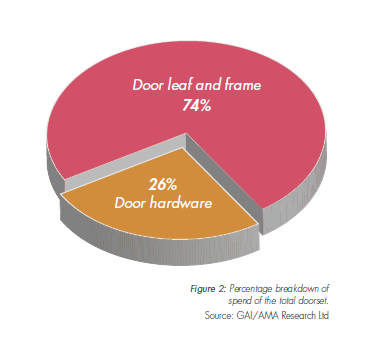
As part of this research, we sought to investigate the percentage breakdown
between the costings for the door leaf itself and the hardware, with the findings
illustrated in Figure 2 (below). It was also found through the research that the highest average spend on doors and hardware is in the office sector. The retail, healthcare and hotel sectors were on average 40% less than this and the industrial and education sector 50% less than this.
Ironmongery & Maintenance Costs….
The second part of the research explored the maintenance aspects of ironmongery and whether the second half of the findings in the 1980’s, namely if “Ironmongery is responsible for 80% of maintenance during the life of a building” was still relevant in today’s business environment. During the research process for this part of the programme representatives from the following types of organisations were contacted:-
•Facilities Management Organisations.
•Door Maintenance Companies.
•Certified UK Installers.
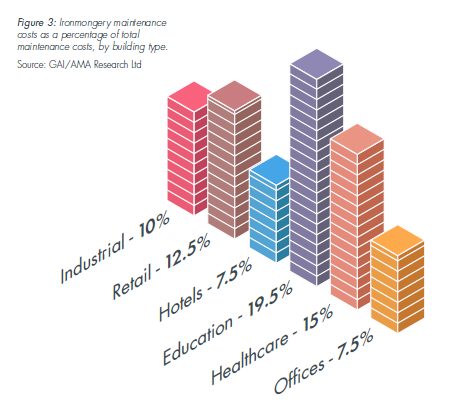
The analysis is based on a representative sample of projects within each end-use sector where comprehensive cost modelling data was available. Figure 3 (below) illustrates the overall analysis.
Conclusions…..
•The 1% spend on ironmongery from the 1980’s is now very much sector specific according to the research.
•Some sectors are higher than that, with healthcare and industrial sectors specifically spending between 1 and 2%, therefore tending towards higher specification.
•Transport and airports have a significantly higher spend, thus showing the importance of high security and high specification.
•The market has moved on significantly since the 1980’s, particularly in terms of building maintenance as newer aspects of maintenance have been introduced and now represent a higher percentage of annual maintenance costs. These include more sophisticated heating and ventilation systems, air conditioning systems and computer technology.
•The impact of increased health and safety regulations and an increase to the UK minimum wage has also impacted this area.
•Advances in technology such as access control products as well as increases in the level of product standards are deemed to have had an impact on spend in the sector.
•Whilst the new research figures on maintenance are lower than the original research it still details the importance of correctly specified ironmongery when up to 19.5% of a maintenance budget can taken up by a product which is on average less than 2% of a project spend.
•Ironmongery also continues to have a significant impact on the value of maintenance and, whilst this percentage of this appears to have decreased since the last research in the 1980’s it is still of huge worth as it is now estimated as being between 7.5% to 19.5% of overall maintenance costs, again depending on market sector.
•A key point raised by respondents was that when any part of the door failed–door leaf, frame, hardware – it presented a major issue for the building occupier as the premises, or part of the premises, would not be capable of being secured properly. This made ironmongery product failure, and the need for replacement, a significant issue – usually one that had to be dealt with either immediately or later the same day.
As many are aware, what is manufactured, specified and supplied in terms of ironmongery is of huge consequence to the construction industry. The increased spend and the substantive impact of this key item on maintenance budgets as demonstrated in the findings of this research still goes a long way towards confirming this.

